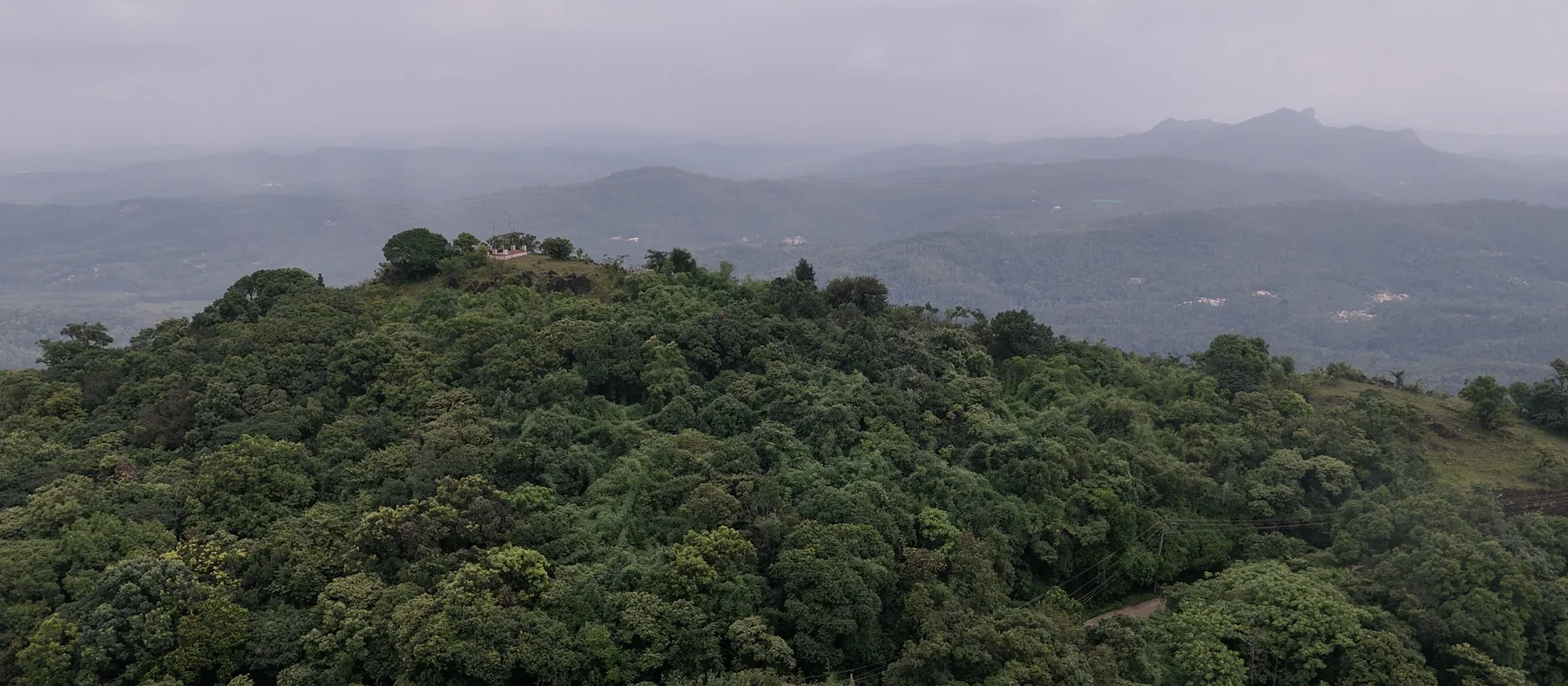
Chikmagalur
The birthplace of Indian coffee, 350 years of continuous cultivation on one range of hills.
Coffee was first cultivated on Indian soil in 1670, on the slopes of Baba Budan Giri. The plant never left: the district now grows more Arabica than any other in India, under two Geographical Indication protections.
GI protected, Chikmagalur Arabica
The origin story
In or around 1670 a Sufi saint known as Baba Budan is said to have returned from pilgrimage to Mecca by way of Mocha, in Yemen. Coffee was under strict monopoly then, and Yemeni exporters were forbidden from letting fertile beans leave the country. He carried seven wrapped at his waist to the Chandragiri hills near his hermitage and planted them beside his cave.
Those seven took. The range was later renamed Baba Budan Giri in his honour and became the seed source for the whole of southern Indian coffee. Commercial European planting followed a century and a half later: in 1820 a planter named Cannon opened ground on the high range immediately south, and cultivation spread through what are now the Chikmagalur and Hassan districts.
Today Chikmagalur is India's second-largest coffee-producing district after Kodagu, and the country's single largest producer of Arabica.
The terroir
Why the range makes exceptional coffee
- One district, the whole altitude spectrum
Robusta off the valley floors and specialty Arabica off the ridge come out of the same district. A buyer can take the full range from one origin instead of splitting contracts across regions.
- A five-fold rainfall gradient
Rainfall varies five-fold between the western and eastern taluks. Every block therefore runs its own water calendar, and cherry maturation curves differ measurably inside a single district.
- Shade is the default, not the exception
The three-tier canopy is simply how coffee is grown here. Dense shade slows ripening the way altitude does, holding sugars and organic acids in the cherry longer.
- A biodiversity hotspot doing the pest control
Native pollinators and predators keep blocks resilient, which is why cultivation on this range carries a lighter chemical load than yield alone would predict.
- Soil that carries the dry cycle
The Malnad's acidic red loam holds moisture after the monsoon ends, carrying plants through the November-to-February gap with minimal irrigation.
- Four centuries without a break
Coffee has grown on these slopes uninterrupted since the 17th century, making the range one of the oldest continuous coffee terroirs anywhere. Method here is inherited rather than imported.
Geographical Indication status
Bababudangiris Arabica
India's 355th GI-tagged product. Registered in 2019, this GI specifically protects Arabica coffee grown on the Baba Budan Giri range, where Baba Budan planted the original seven Yemeni beans. Signature cultivar recognised in the GI documentation is Selection 795 (S.795) a natural descendant of two of the oldest African coffee cultivars. Selectively hand-picked and typically naturally fermented; profile carries mild acidity, striking aroma, and chocolate notes.